Mary Jo Webb
Killers of the Flower MoonMary Jo Webb is a retired teacher who spent decades investigating the suspicious death of her grandfather, Paul Peace, during the Osage Reign of Terror. In the book, her inquiry brings an overlooked family case into view: Peace suspected he was being poisoned, sought legal help to change his life and will, and died after being struck by a car. Webb could not name his killer, but she preserved documents and family testimony that show how a death could disappear from official files while continuing to shape the lives of descendants.
Identity and Background
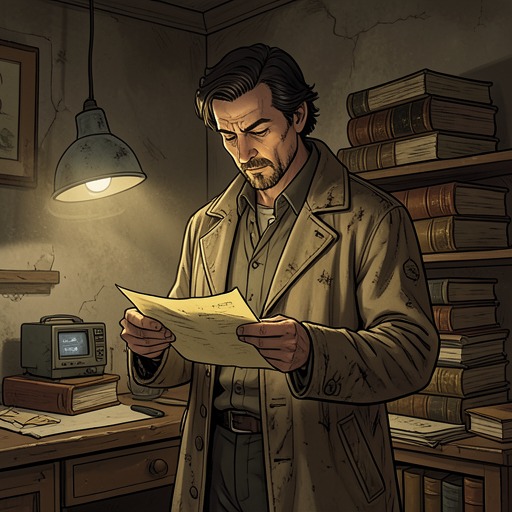
When the narrator visited Osage County before leaving for home, Webb was in her eighties and living in a single-story wooden house in Fairfax, not far from where the Smith family home bombing had taken place. Frail, with a quavering voice, she welcomed the visitor into her living room. Her decades of research had made her a family investigator as well as a retired teacher: she had gathered guardian expense reports, probate records, and court testimony relating to Paul Peace’s case.
Webb described her grandfather as one of the victims who did not appear in the FBI files and whose killers never went to prison. That account establishes both the focus and the limits of her work. Her documents offered a means of recovering events that formal investigations had failed to preserve, but they could not supply a settled answer about who was responsible. Webb’s story is not a solved case; it is a record of a descendant continuing to ask what happened when the record itself is incomplete.
Paul Peace’s Suspicion and Death
In December 1926, Peace suspected that his white wife was poisoning him. He went to see Comstock, whom Webb described as one of the few decent white attorneys of the time, because he wanted a divorce and intended to change his will so that his wife would not inherit from him. A witness later testified that Peace had said his wife was feeding him “some kind of poison, that she was killing him.” The threat he perceived was therefore connected to specific steps he was trying to take: leaving the marriage and altering the disposition of his property.
Webb offered a family explanation for how poison might have been obtained. Recalling what her mother had said, she spoke of two doctor brothers and of a local understanding that people went to them for the means to poison Osage people. Her account points to suspected access to poison without establishing that those doctors poisoned Peace, or that his wife did. The distinction matters: the surrounding history contains suspicions and allegations that could not always be proved, and Webb’s evidence does not resolve the identity of Peace’s killer.
On February 23, 1927, only weeks after Peace had vowed to divorce his wife and disinherit her, he was injured in a hit-and-run and left to bleed out on the road. Webb believed familiar forces had conspired to paper over what happened. The timing gives the death a troubling relation to Peace’s expressed plans, but the book does not identify a proven perpetrator or establish that the hit-and-run was part of a demonstrated murder plot. Webb’s appeal, “Maybe you could look into it,” leaves the question open rather than pretending that suspicion is certainty.
Family Archive and Unresolved Investigation
Webb’s boxes of records make her living room a counterpoint to the gaps in official documentation. Guardian expense reports, probate records, and court testimony preserve traces of a case that, in her description, did not register in the FBI files. Together with her account of Peace’s visit to Comstock and his stated fear of poison, these materials allow the narrator to reconstruct the decisions Peace was trying to make before his death. They do not, however, close the case. The archive can establish that there were documents and testimony to examine without turning them into proof of an unrecorded conclusion.
The uncertainty in Webb’s case echoes the difficulties faced by other descendants investigating deaths from the same period. Some families suspected relatives, guardians, or local associates but could not determine whether those suspicions were right. The book describes murders concealed through networks that included people able to falsify death certificates or bury bodies quickly, as well as institutions and prominent citizens who did not stop criminal activity. Against that larger pattern, Webb’s account illustrates why a family could inherit questions that the contemporary investigation had not answered. Her work recovers a name and a set of circumstances, but not the final accounting that the survivors were denied.
Memory and Narrative Significance
Webb’s visit comes near the close of the narrator’s journey through Osage County. The encounter shifts the focus from the famous cases and their convictions to a death that remained unresolved. She has not simply kept old paperwork: by bringing it out for a visitor, she makes a private investigation legible beyond the family and asks that the case be looked at again. Her appeal also exposes the difference between a story being absent from an investigative file and being absent from family memory. Paul Peace was not forgotten by the people who kept searching for an explanation.
On the porch at dusk, with the town and street empty and the prairie beyond, Webb described the land as saturated with blood. She then repeated the biblical words, “The blood cries out from the ground.” The image gathers her grandfather’s death, the incomplete archive, and the continuing work of remembrance into a final scene without suggesting that the crime has been solved. Webb’s place in the narrative is that of a descendant who preserves evidence and insists on attention, even when the surviving record cannot name the person responsible. Her investigation gives the unresolved past a witness, while its unanswered questions remain part of the story.